Exploring the transition from education to work, friendships, and community life for neurodivergent young adults
Every year, thousands of families across India celebrate a milestone they have worked toward for years: completing school.
For many of these families, it is a moment of genuine pride. Years of therapy, learning, advocacy, Individualized Education Plans, and quiet persistence have finally led to graduation.
And then, almost immediately, comes the question that arrives quietly but weighs heavily:
What happens next?
Will my son or daughter find meaningful work? Will they have friends? Will they belong somewhere? Will they continue learning and growing? Who will support them when we are no longer able to?
For families of neurodivergent young adults — particularly those with autism, intellectual disabilities, and other developmental disabilities — these questions are not simply personal concerns. They reflect one of the most significant yet least-discussed social challenges facing India today.
The Hidden Crisis After School
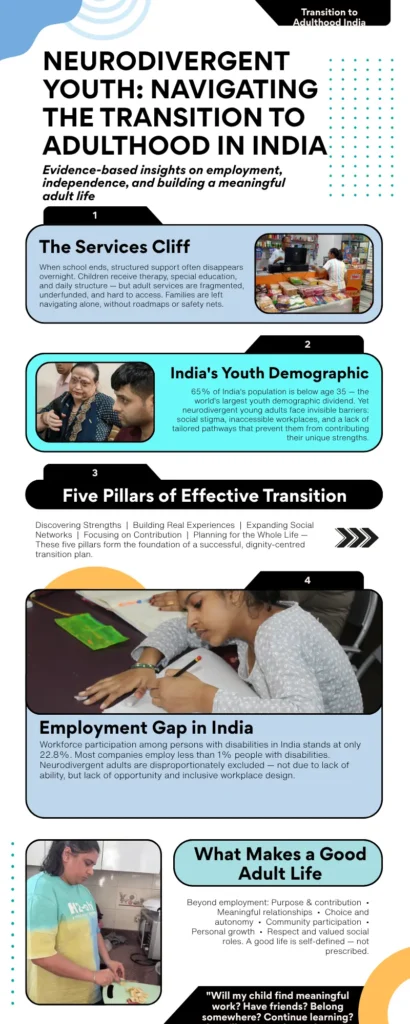
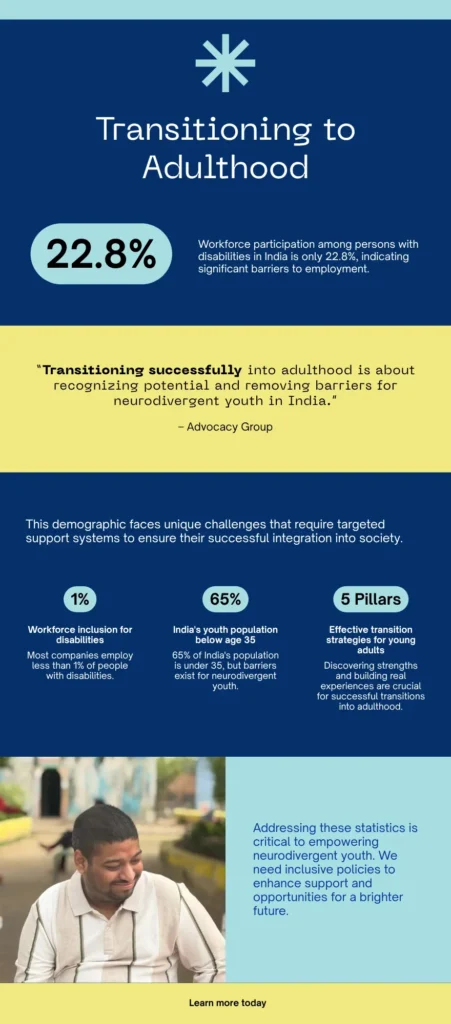
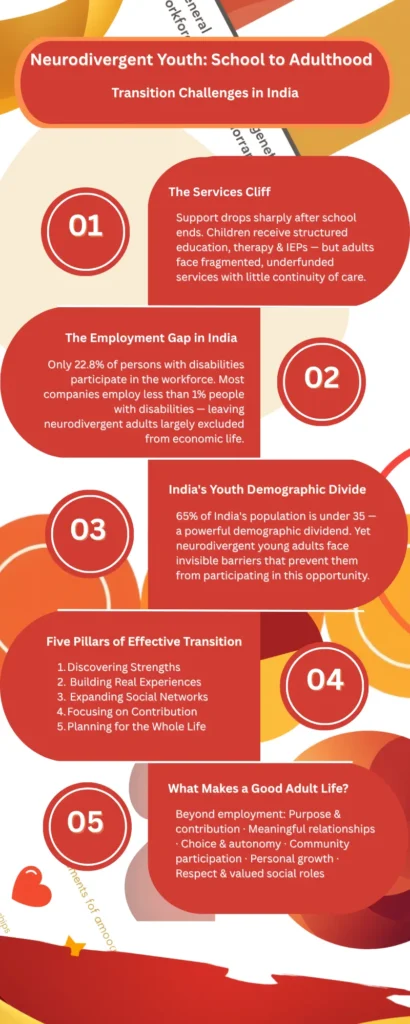
As India positions itself as the world’s youngest major economy — with nearly 65% of its population below the age of 35 — the conversation around youth development is everywhere. Yet within this demographic dividend are millions of young people with disabilities whose transition into adulthood remains largely invisible in public policy, workforce planning, and community life.
For most young people, adulthood unfolds through a series of transitions: higher education, employment, friendships and relationships, independent mobility, community participation, and citizenship.
For many neurodivergent young adults, these pathways are far less accessible.
School provides more than academics. It offers structure, routine, relationships, expectations, and opportunities for participation. Teachers, classmates, therapists, and activities create a network that gives young people a place in the community.
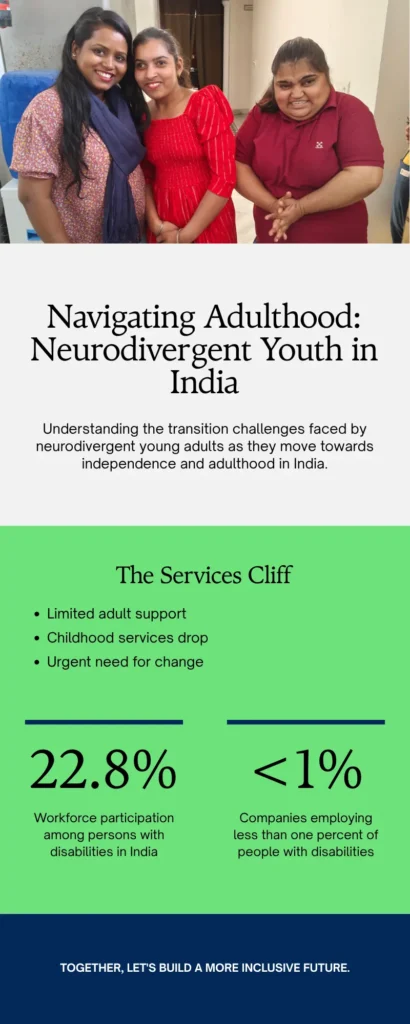
Once school ends, many families find themselves facing what disability advocates have long called the “services cliff” — a sudden, sharp reduction in support and opportunity. Research consistently shows that many young adults with disabilities struggle to move into employment, further education, or meaningful community participation after leaving school, with young adults on the autism spectrum experiencing some of the highest rates of disconnection among all disability groups.
The challenge is not the disability itself. The challenge is that India has invested significantly more in childhood services than in creating pathways into adult life.
Education Has Expanded Faster Than Opportunity
India has made important progress in disability rights. The Rights of Persons with Disabilities Act, 2016 expanded recognised disability categories, strengthened protections, and emphasised inclusion in education and employment. The National Education Policy 2020 further highlighted inclusive education and equitable participation.
Yet a critical gap remains.
Across India, increasing numbers of neurodivergent children are entering schools, therapy programmes, and skill-building initiatives. Far fewer are entering meaningful employment, community leadership roles, or independent adult lives.
Research based on India’s National Sample Survey data found that workforce participation among persons with disabilities remains extremely low, at approximately 22.8%. Employment outcomes are strongly shaped by education, accessibility, transport, income, and social barriers.
This means that for many families, graduation is not followed by opportunity.
It is followed by waiting.
The Real Goal Is Not Employment Alone
When families ask, “What happens after school?” they are often really asking something much deeper: “Will my child have a good adult life?”
A good adult life includes employment — but it requires far more. It requires:
- Purpose and contribution
- Meaningful relationships
- Choice and autonomy
- Community participation
- Personal growth
- Respect and valued social roles
A person can attend a programme every day and still be isolated. A person can receive benefits and still feel excluded. A person can be safe and still not have a life they value.
This is where the principles of Social Role Valorization (SRV) become especially relevant. SRV asks a powerful question: What socially valued roles does this person hold?
Are they known as an employee, a colleague, a volunteer, an artist, a neighbour, a friend, a teammate? Or are they known only through disability services?
The difference matters profoundly — because valued social roles shape how people are perceived, included, and respected by the communities around them. The question therefore shifts from “What programme will they attend?” to “What roles will they hold?”
Employment: From Charity to Contribution
India’s disability employment conversation often swings between two extremes. One views employment as unrealistic. The other treats it as charity. Neither approach works.
Employment should be understood as contribution.
Traditional approaches often underestimate neurodivergent individuals by focusing on deficits rather than strengths. A more effective question is not “What can’t this person do?” but rather “What strengths can this person contribute?”
This is the foundation of Customised Employment — matching an individual’s strengths with unmet needs in workplaces. A 2024 randomised controlled study found that transition-age youth with intellectual and developmental disabilities who participated in customised employment were significantly more likely to achieve competitive, integrated employment than those receiving traditional services.
Consider what this looks like in practice:
The young man who loves organising objects may excel in inventory management, stock organisation, or library support roles — not because these are “easy” jobs, but because his strengths create genuine value.
The young woman passionate about art may contribute through graphic design assistance, product creation, community exhibitions, or creative entrepreneurship — far beyond what a hobby programme could offer.
The young adult fascinated by technology may find opportunities in data management, digital archiving, testing, or administrative support — with their attention to detail becoming an asset.
The goal is not simply to “place” someone in a job. The goal is to discover where a person’s strengths create real value for others.
The Socio-Economic Reality
India’s disability experience is deeply shaped by socio-economic realities. Many families supporting neurodivergent adults are simultaneously navigating rising healthcare costs, limited social security, inaccessible transportation, caregiving responsibilities, housing concerns, and loss of income due to caregiving demands.
Research has repeatedly shown significant differences in employment outcomes based on geography, education levels, gender, and household resources. Adult disability services remain unevenly distributed across urban and rural India. As a result, adulthood is often experienced very differently depending on where a family lives and what resources they possess.
The deepest anxiety many parents carry is not about today — it is about the future: “What happens when we are no longer able to care for our child?”
This question deserves a serious, systemic answer. It cannot remain a private worry carried by families alone.
Friendship: The Forgotten Outcome
Perhaps the most overlooked aspect of adulthood is friendship.
Schools naturally create opportunities for social interaction. Adult life often does not.
Many neurodivergent adults in India experience profound social isolation after leaving school. Parent narratives frequently describe shrinking social circles and limited opportunities for meaningful peer relationships after graduation. Yet loneliness may be one of the greatest challenges neurodivergent adults face — and friendships are not a luxury. They are essential to wellbeing.
Friendships cannot be programmed into existence. They emerge through shared interests, repeated interactions, and genuine belonging.
This means effective transition planning should include questions such as:
- Who spends time with this person?
- Where can they meet peers?
- What shared interests can create connections?
- Who knows and values this person outside their family and service providers?
A job without relationships can still be lonely. A successful transition is not merely one where a young person is occupied — it is one where they are genuinely connected.
Community Life Matters More Than Programmes
India has traditionally relied on institution-based approaches to disability support. But adulthood happens in communities, not programmes.
Research and disability rights frameworks increasingly emphasise inclusion within ordinary community life. Children and adults with disabilities experience better outcomes when barriers to participation are removed and communities become more inclusive.
Belonging develops when people participate in everyday life: taking public transport, shopping locally, joining clubs, attending cultural events, volunteering, participating in religious communities, playing sports, and using public spaces.
The more visible neurodivergent adults become within communities, the more familiar and accepted they become. Inclusion is not created by awareness campaigns alone. It is created through shared experiences.
The Dignity of Risk
One of the hardest parts of transition is for families themselves.
Parents spend years protecting their children. Adulthood requires a gradual shift toward supporting choice and self-determination — including accepting the dignity of risk.
Adults learn by trying, succeeding, failing, adapting, and trying again. A first job may not work out. A friendship may end. A commute may be difficult. A mistake may happen.
These experiences are not signs of failure. They are part of becoming an adult. When opportunities are removed in the name of protection, growth often disappears with them.
Laws Are Necessary but Not Sufficient
India has some of the strongest disability legislation in its history. Yet implementation remains inconsistent.
Recent data shows that representation of persons with disabilities in corporate workforces remains extremely low — often below 1% — despite growing public commitments to diversity and inclusion. The challenge before policymakers is no longer simply creating laws. It is creating systems that translate rights into everyday opportunities.
A right to employment must lead to jobs. A right to education must lead to adult outcomes. A right to inclusion must lead to belonging.
What Effective Transition Planning Looks Like
Research on school-to-work transition highlights several factors that consistently improve outcomes: vocational guidance, work-based learning experiences, skill development, expanded social networks, and individualised planning that begins long before graduation.
Effective transition planning focuses on five pillars:
1. Discovering Strengths What does this person enjoy? What are they good at? What environments help them succeed?
2. Building Real Experiences Internships, volunteering, job shadowing, and community participation create genuine pathways — not theoretical ones.
3. Expanding Social Networks Relationships often lead to opportunities more effectively than formal programmes alone.
4. Focusing on Contribution What value can this person bring to others and to their community?
5. Planning for the Whole Life Employment matters, but so do friendships, recreation, health, citizenship, and a sense of belonging.
Families do not need another waiting list. They need pathways.
A Different Question for India
As India prepares millions of young people for the future, we must ask ourselves honestly:
What kind of future are we helping to build for neurodivergent youth?
Because the real question is not “What happens after school?” The real question is: “What happens after society stops expecting growth?”
Every young person deserves the opportunity to continue learning, contributing, making friends, taking risks, and building an adult identity — regardless of their disability.
The future of disability inclusion in India will not be measured by how many children enter school. It will be measured by how many adults find valued roles, meaningful work, genuine friendships, and a place where they truly belong.
The most successful transitions are not those that move people from one system to another. They are the ones that help people move into valued roles, meaningful relationships, and genuine community life.
That is what adulthood should look like — for every young person.
References
- Singal, N., & Jeffery, R. (2009). Transitions to adulthood for young people with disabilities in India: Current status and emerging prospects. Asia Pacific Disability Rehabilitation Journal.
- Narayan, S., & Srikanth, G. (2020). Challenges in transitioning to adulthood for individuals with Autism Spectrum Disorder in India. IOSR Journal of Humanities and Social Science.
- Khatoon, F. (2026). Employment status of persons with disabilities in India: Insights from National Sample Survey Data 2018. Social Sciences & Humanities Open.
- Rajasulochana, S. R., & Khan, M. I. (2024). Does access to assistive technologies enhance labour force participation amongst the disabled population? Evidence from India.
- Naraharisetti, R., & Castro, M. C. (2016). Factors associated with persons with disability employment in India. BMC Public Health.
- Inge, K. J., Wehman, P., Avellone, L., Broda, M., & McDonough, J. (2024). The impact of customized employment on the competitive integrated employment outcomes of transition age youth with intellectual and developmental disabilities. Work.
- Coñoman, G. I., Ávila, V., & Carmona, C. (2024). Initiatives to support the school-to-work transition of people with intellectual disabilities: A systematic review. Journal of Intellectual & Developmental Disability.
- Drexel University Autism Outcomes. Transition to Adulthood.
- UNICEF. Supporting Adolescent Transition to Adulthood.
- UNICEF. Children and Adolescents with Disabilities.
- Times of India. (2026). India talks diversity, but most companies employ less than 1% people with disabilities.