Tackling Stereotypes · Article 2 of a Series — Changing the Story from Devaluation to Dignity
“Pity may appear compassionate, but it often becomes one of the greatest barriers to dignity and inclusion.”
Imagine introducing someone by saying: “This is Rahul. Poor thing… he has autism.” Or, “She suffers from Down syndrome.” Or, “Please help these unfortunate children.”
These words are often spoken with kindness. There is no intent to hurt. Yet they reveal one of the oldest and most persistent stereotypes surrounding disability — the Object of Pity.
Pity may seem harmless, even compassionate. But beneath it lies an unequal relationship. It places one person above another: the helper above the helped, the capable above the incapable, the giver above the receiver.
People with disabilities do not want to be admired for surviving or pitied for existing. Like everyone else, they want to be respected, included, challenged, trusted, and recognised for their contributions.
The real question is not whether people with disabilities deserve our sympathy. It is whether they deserve the same dignity, expectations, and opportunities as everyone else.
The answer is unequivocally yes.
Understanding the “Object of Pity”
Social Role Valorization (SRV), developed by Dr. Wolf Wolfensberger, explains that society often assigns devalued social roles to people who are perceived as different or vulnerable. One of these roles is the Object of Pity.
Rather than being viewed as capable individuals with strengths, people become defined by what they supposedly lack. Their disability becomes the most important thing about them. Society begins to see them as unfortunate, helpless, dependent, tragic, incapable — permanently in need of rescue.
Although pity appears positive on the surface, SRV explains that it reinforces devaluation because it lowers expectations and limits opportunities. Instead of asking “What can this person contribute?” society asks “How can we help this poor person?” That shift changes everything.
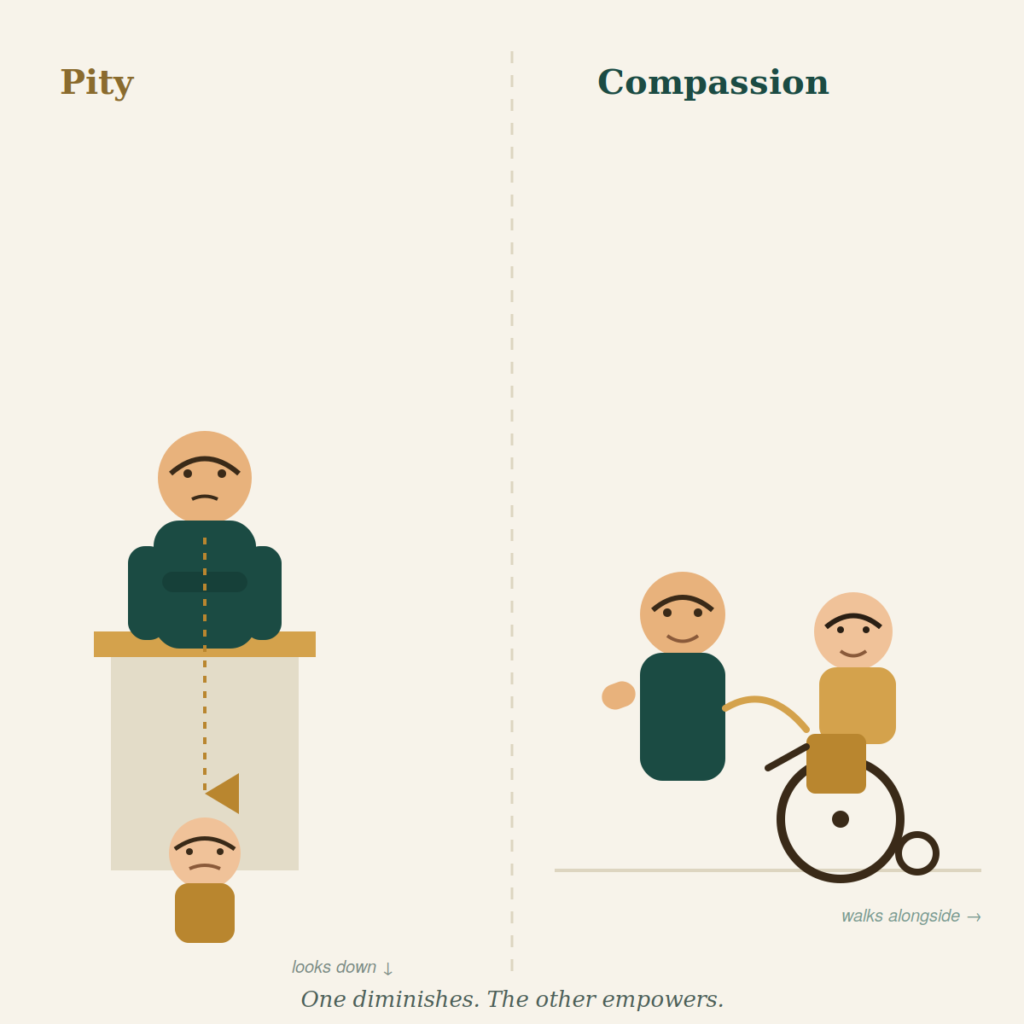
Pity Is Not the Same as Compassion
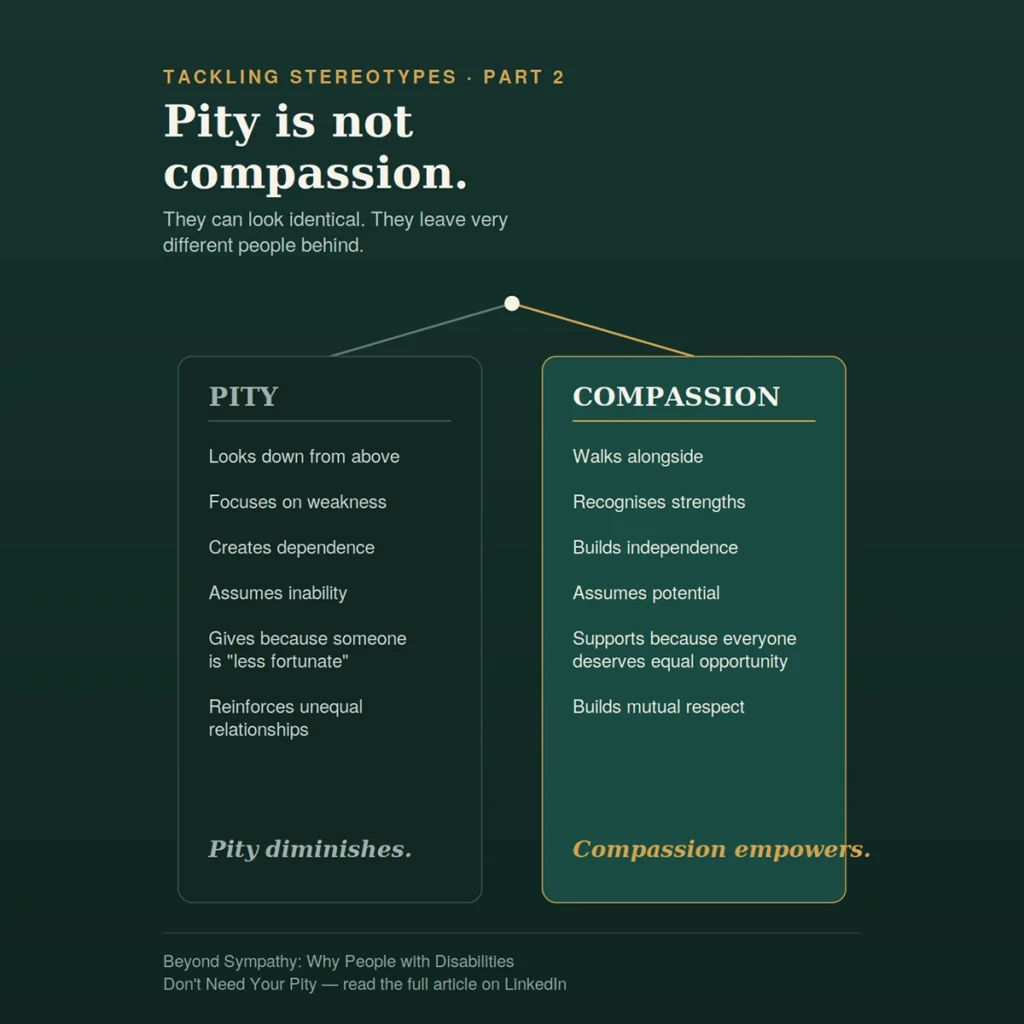
One of the greatest misconceptions is confusing pity with empathy. They can look identical from the outside — a kind word, a helping hand — but they leave very different people behind.
Pity vs. Compassion:
- Looks down from above → Walks alongside
- Focuses on weakness → Recognises strengths and challenges
- Creates dependence → Builds independence
- Assumes inability → Assumes potential
- Gives because someone is “less fortunate” → Supports because everyone deserves equal opportunity
- Reinforces unequal relationships → Builds mutual respect
Compassion empowers. Pity diminishes.
Where Does Pity Come From?
Historically, disability was viewed through the charity model. People with disabilities were portrayed as helpless individuals dependent on the generosity of others — a perspective reinforced by religious interpretations of suffering, institutional care, segregated education, and decades of fundraising campaigns built on sad imagery and hopeless narratives.
The message was simple: feel sorry enough to donate. While these campaigns often raised funds, they also shaped public attitudes. People learned to associate disability with tragedy rather than possibility.
How Pity Shapes Everyday Life
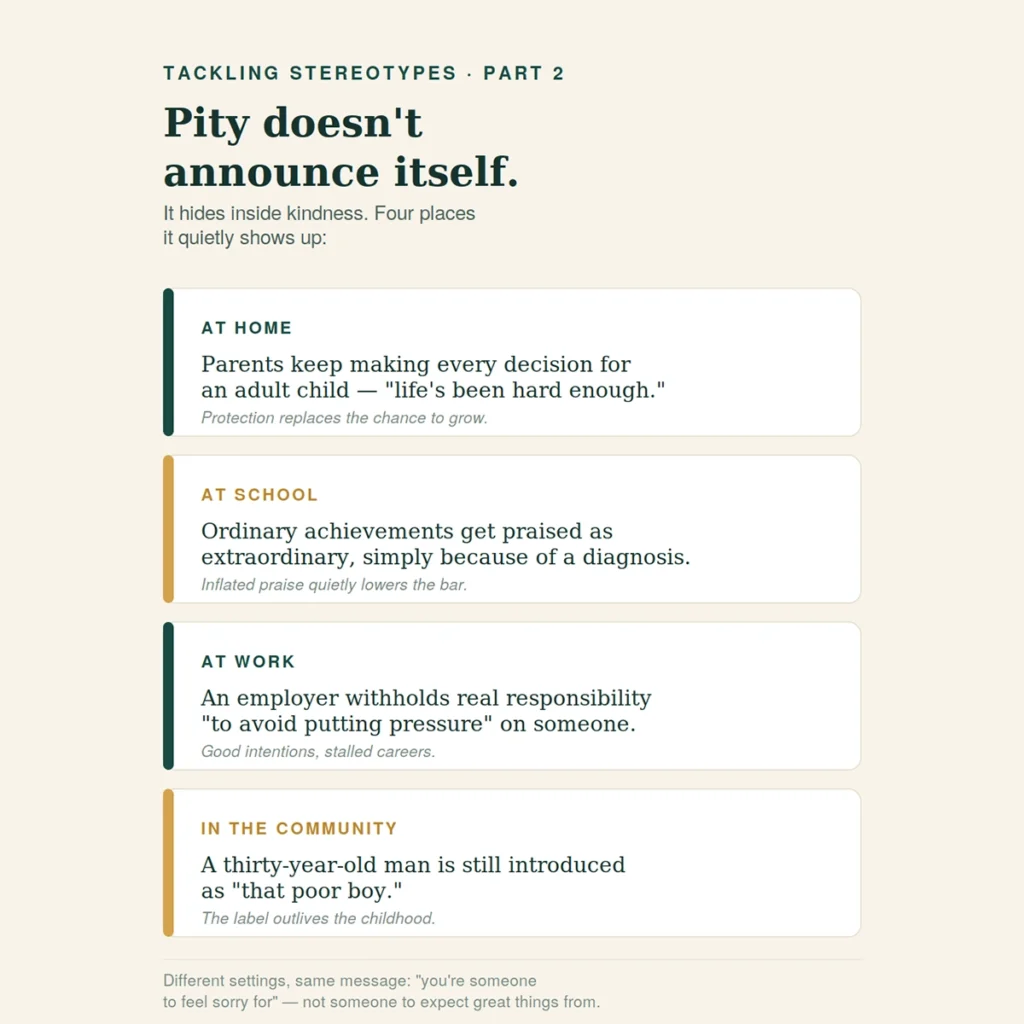
Unlike overt discrimination, pity is subtle. It hides behind kindness.
- At home: Parents keep making every decision for an adult child — “life’s been hard enough.” Protection replaces the chance to grow.
- At school: Ordinary achievements get praised as extraordinary, simply because of a diagnosis. Inflated praise quietly lowers the bar.
- At work: An employer withholds real responsibility “to avoid putting pressure” on someone. Good intentions, stalled careers.
- In the community: A thirty-year-old man is still introduced as “that poor boy.” The label outlives the childhood.
Different settings, same message: “you’re someone to feel sorry for” — not someone to expect great things from.
The Hidden Price of Pity
Pity does more than hurt feelings. It shapes opportunities. Research consistently shows that expectations influence outcomes. When families, educators, employers, and communities expect less, they offer fewer opportunities to learn, work, lead, and participate — and people begin to internalise those lowered expectations.
This phenomenon, known as the Pygmalion Effect, demonstrates that higher expectations often lead to improved performance, while persistently low expectations can limit achievement and confidence. In disability, pity often becomes low expectations disguised as kindness.
Devalued Roles vs. Valued Roles
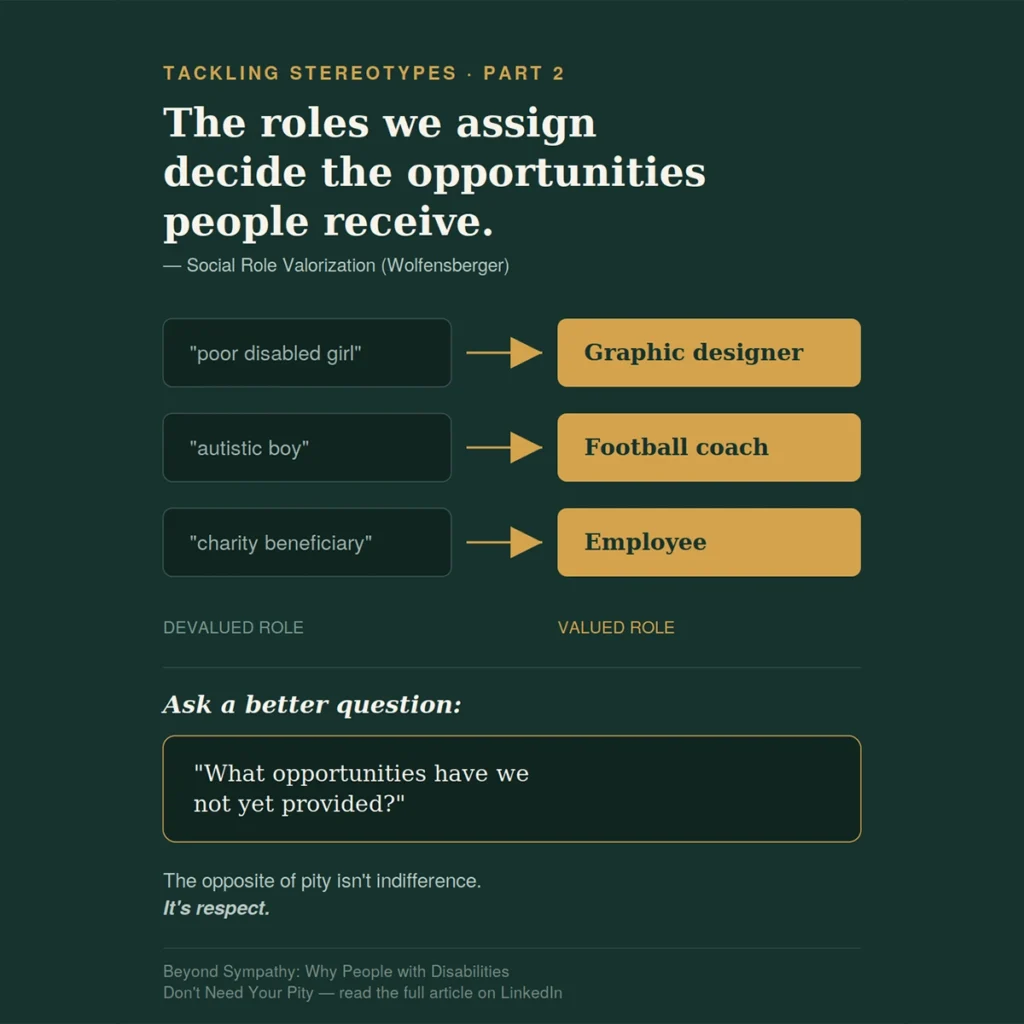
SRV teaches that society grants opportunities based largely on the roles people occupy. When someone is seen as “the poor child” or “the unfortunate one,” they are less likely to be viewed as an employee, a leader, a neighbour, a student, or an entrepreneur. The stereotype itself becomes a barrier.
SRV encourages replacing pity with valued social roles. Instead of seeing disability first, society begins recognising identity:
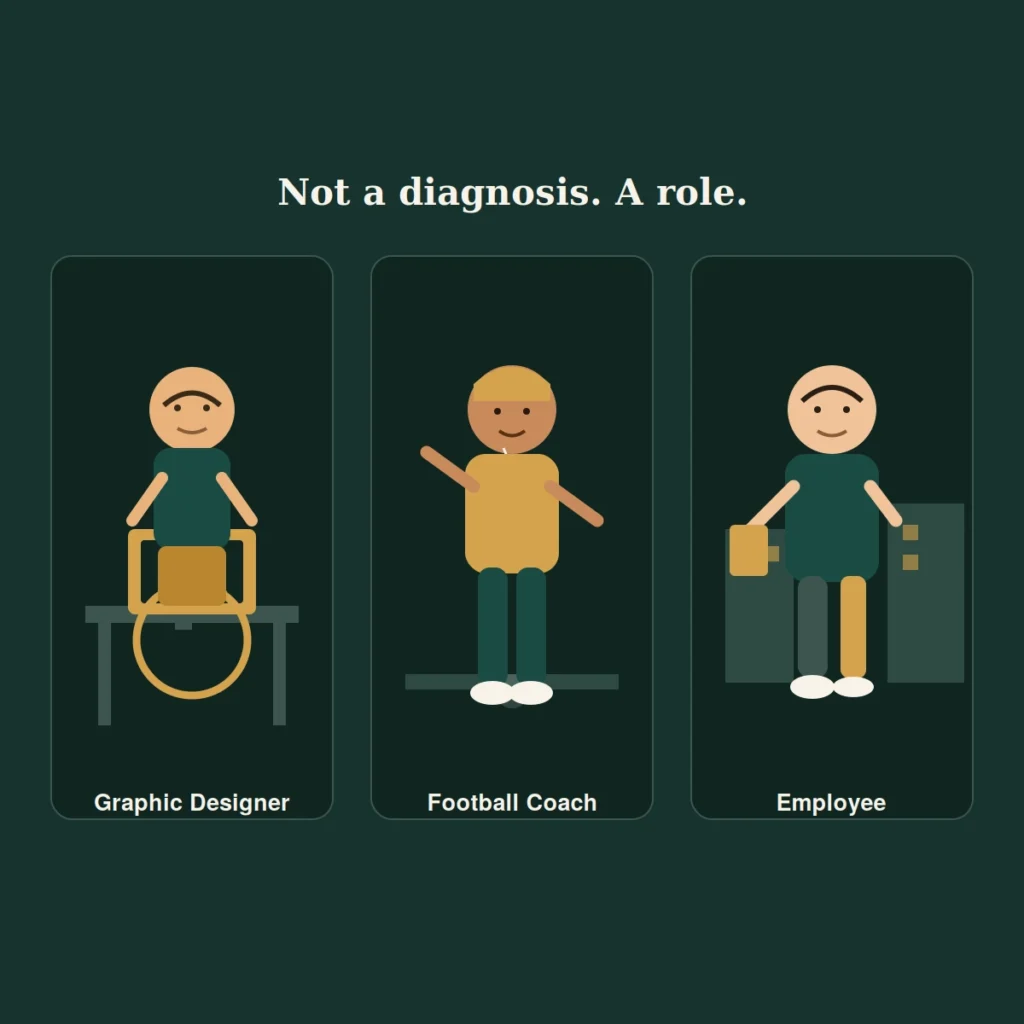
- Not “poor disabled girl” — Graphic designer.
- Not “autistic boy” — Football coach.
- Not “charity beneficiary” — Employee.
The “Inspiration” Trap
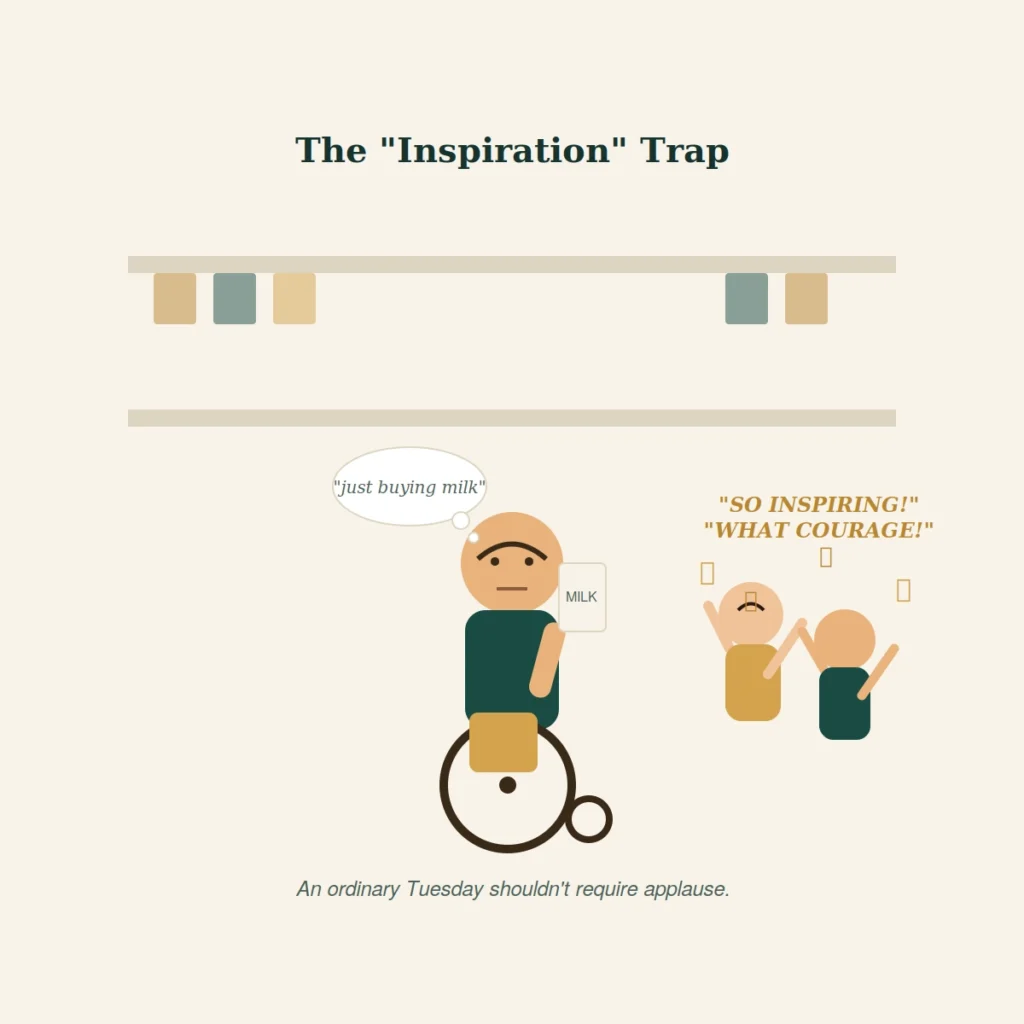
Pity has evolved. Today it often appears as inspiration porn, a term coined by disability advocate Stella Young. People with disabilities are celebrated simply for going to school, getting married, holding a job, or shopping independently.
The underlying assumption is: “If someone with a disability can do this, everyone else has no excuse.” While intended as praise, this framing objectifies people and turns ordinary lives into motivational tools for others.
The real achievement was never that a person with a disability exists. The achievement is overcoming barriers created by society.
What Does Dignity Look Like Instead?
Dignity means expecting adulthood, contribution, and participation. It means asking “What support would enable this person to succeed?” instead of “Should they even try?” It means recognising that every person has strengths worth developing.
Practical Ways to Challenge the Stereotype
Every one of us can help shift attitudes — the change starts in the roles we already occupy.
- Families: Replace overprotection with supported independence. Speak about strengths as often as support needs. Encourage age-appropriate responsibilities.
- Educators: Maintain high expectations. Celebrate genuine achievement without infantilising praise. Promote leadership opportunities.
- Employers: Recruit based on skills. Provide reasonable accommodations. Focus on contribution rather than limitations.
- Media Professionals: Tell stories of participation, not pity. Avoid portraying disability solely through suffering. Include people with disabilities as storytellers.
- Community Members: Speak directly to the person. Use respectful, person-centred language. Offer opportunities to participate, volunteer, and lead.
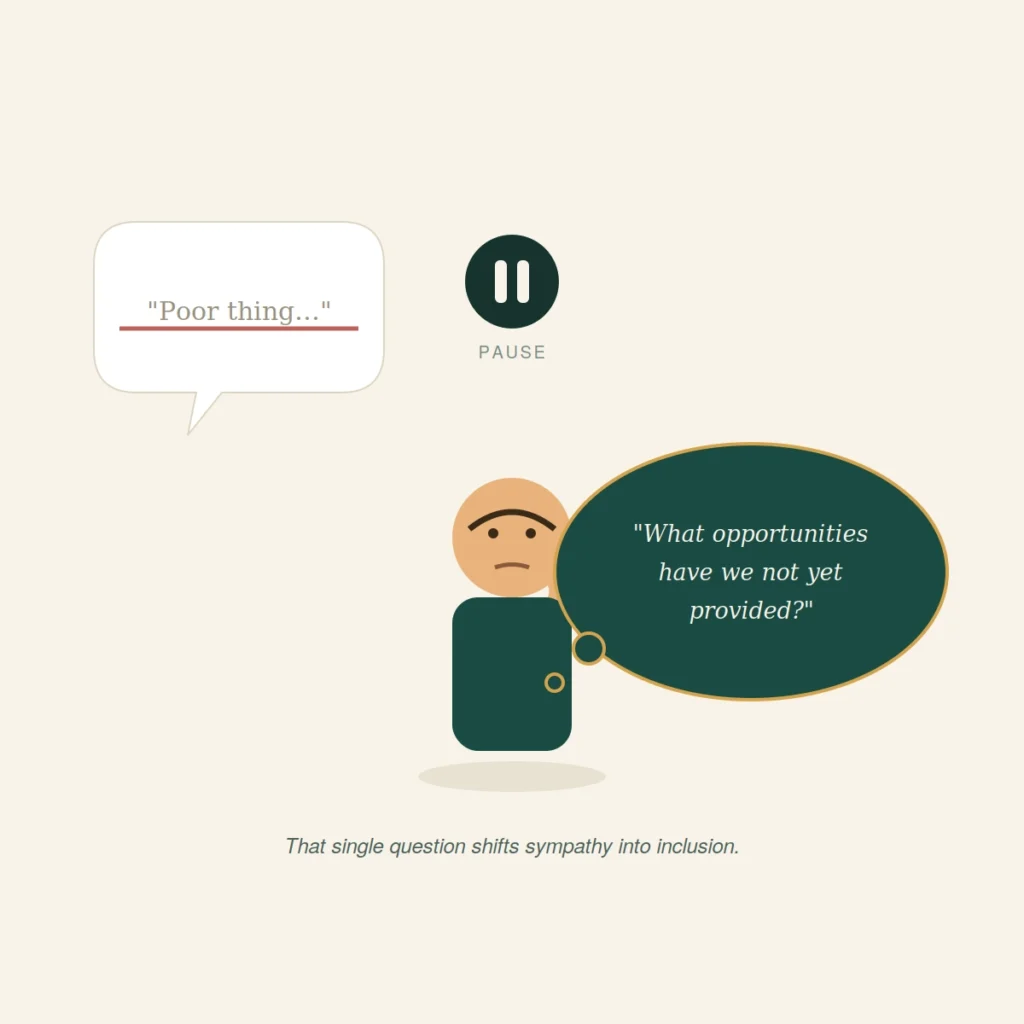
- Everyone: When you hear “poor thing…” — pause. Ask a better question instead.
“What opportunities have we not yet provided?”
That single question shifts the conversation from sympathy to inclusion.
From Pity to Partnership
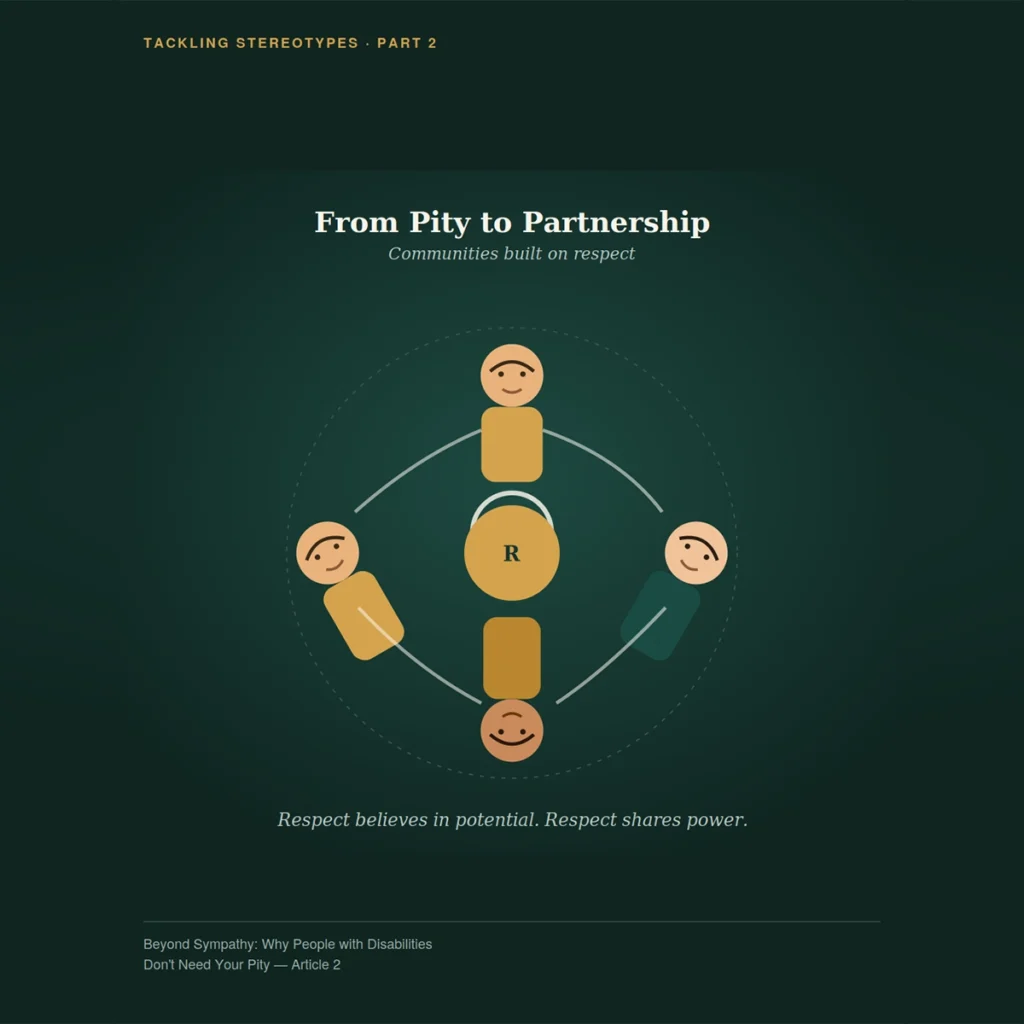
True inclusion is not about rescuing people. It is about removing barriers. People with disabilities do not need lives built on sympathy. They need communities built on respect.
As Social Role Valorization reminds us, the roles society assigns determine the opportunities people receive. If we continue assigning the role of Object of Pity, we will continue producing exclusion. But if we replace that role with student, colleague, leader, artist, volunteer, entrepreneur, neighbour, and citizen, we begin to transform not only public attitudes but also lives.
Final Reflection: Respect, Not Rescue
The opposite of pity is not indifference. It is respect. Respect believes in potential. Respect expects contribution. Respect shares power. Respect creates opportunity. And respect recognises that disability is not a tragedy.
Exclusion is.
As we continue this series, let us challenge not only the stereotypes we hear in society but also the ones we may unknowingly hold ourselves. Changing attitudes begins with changing the roles we assign — and the stories we choose to tell.
Coming Next in the Series
Article 3: Charity Is Not Enough — Breaking the “Burden of Charity” Stereotype. We’ll explore why people with disabilities should not be viewed merely as recipients of help, but as active contributors to society, and how shifting towards rights, inclusion, and valued social roles creates lasting social change.
References:
- Wolfensberger, W. (1983). Social Role Valorization: A Proposed New Term for the Principle of Normalization. Syracuse University Training Institute.
- Race, D., Boxall, K., & Carson, I. (2005). Towards a Dialogue for Practice: Reconciling Social Role Valorization and the Social Model of Disability. Disability & Society, 20(5), 507–521.
- Armstrong, M. (2006). The Application of Social Role Valorization in Supporting People with an Intellectual Disability.
- Wolfensberger, W. (1998). A Brief Introduction to Social Role Valorization.
- United Nations. (2006). Convention on the Rights of Persons with Disabilities (CRPD).
- World Health Organization & UNICEF. (2023). Global Report on Children with Developmental Disabilities: From the Margins to the Mainstream.
- World Health Organization. (2011). World Report on Disability.
- United Nations. (2024). Disability-Inclusive Communications Guidelines.
- Rosenthal, R., & Jacobson, L. (1968). Pygmalion in the Classroom. Holt, Rinehart & Winston.
- Shakespeare, T. (2018). Disability: The Basics. Routledge.
- Oliver, M. (1990). The Politics of Disablement. Macmillan Education.
- Young, S. (2014). I’m Not Your Inspiration, Thank You. TEDxSydney.