The Role of Peer Relationships in Independence, Wellbeing, and Valued Social Roles
When families think about preparing their children for adulthood, they often focus on education, therapies, employment, daily living skills, and safety. These are all important. Yet one of the strongest predictors of a meaningful adult life is often overlooked: friendship.
Every young adult needs at least one genuine friend outside their family.
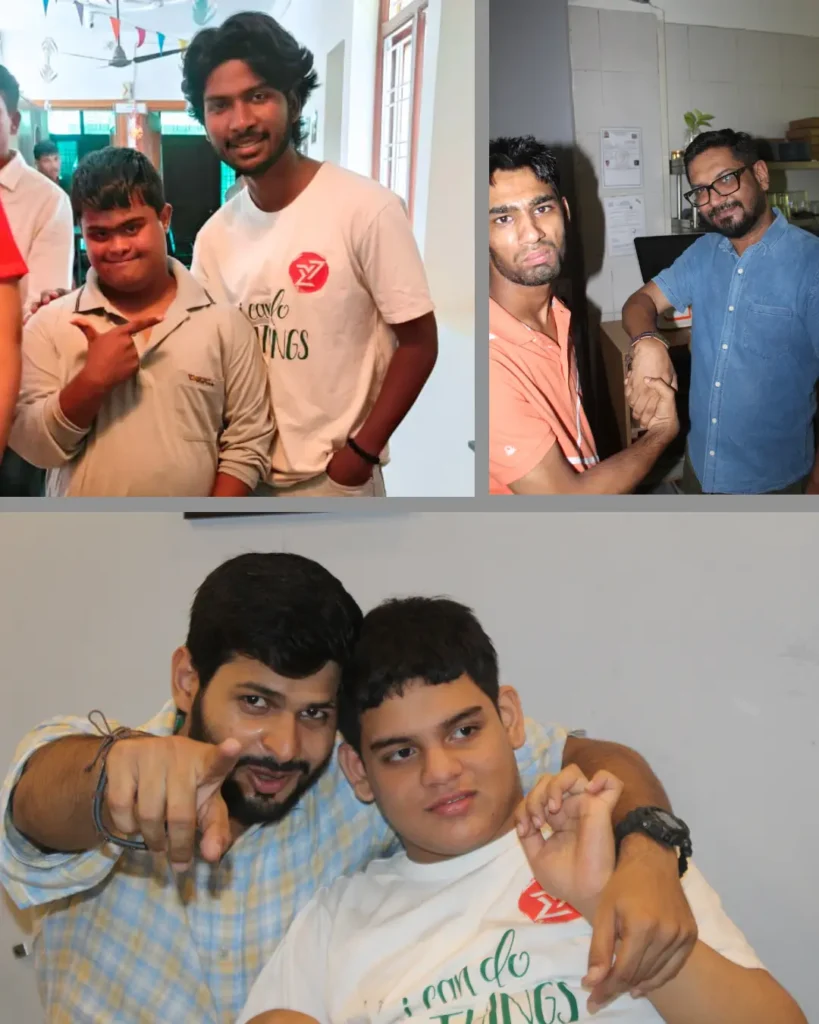
A friend is not a parent, therapist, teacher, support worker, or caregiver. A friend is someone who chooses to spend time with you, shares experiences with you, enjoys your company, and values you as an equal. These relationships play a critical role in emotional wellbeing, identity formation, independence, and community belonging.
For young adults with autism and developmental disabilities, friendship is often harder to access than education or therapy. Many spend most of their time with family members, support professionals, or other people with disabilities. While these relationships may be supportive, they cannot replace authentic peer relationships.
The question is not whether friendship is important. The question is whether we are creating lives that make friendship possible.
What the Research Says About Friendship
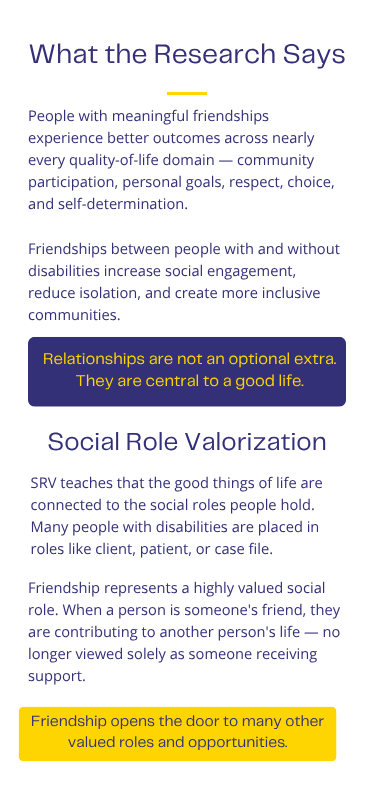
Research consistently shows that friendships contribute significantly to quality of life, mental health, self-determination, and community participation.
A landmark study by Friedman and Rizzolo found that people with intellectual and developmental disabilities who had meaningful friendships experienced better outcomes across nearly every quality-of-life domain, including community participation, personal goals, respect, relationships, choice, and self-determination. Individuals with friendships were significantly more likely to experience valued life outcomes than those without them.
Researchers have also found that authentic friendships provide emotional support, opportunities for reciprocity, greater social inclusion, and a stronger sense of belonging. Unlike paid support relationships, friendships are based on mutual choice and shared interests.
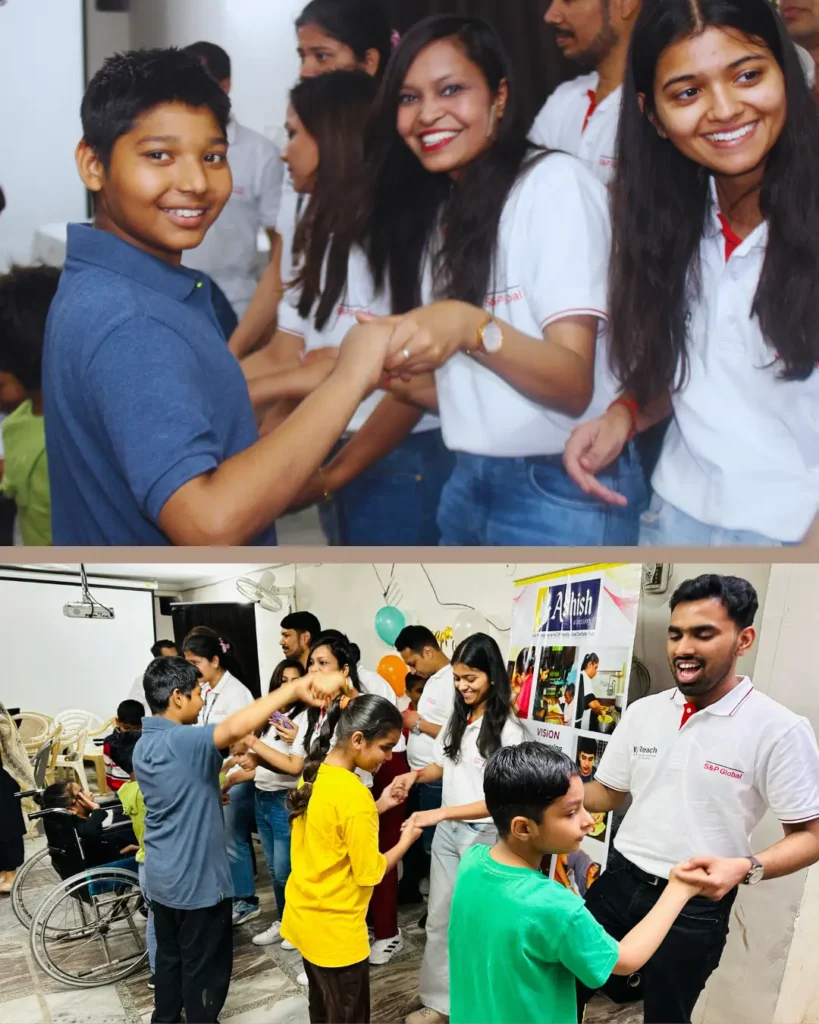
In recent studies, friendships between people with and without disabilities have been shown to increase social engagement, reduce isolation, and create more inclusive communities. These relationships benefit everyone involved—not only the person with a disability.
The evidence is clear: relationships are not an optional extra. They are central to a good life.
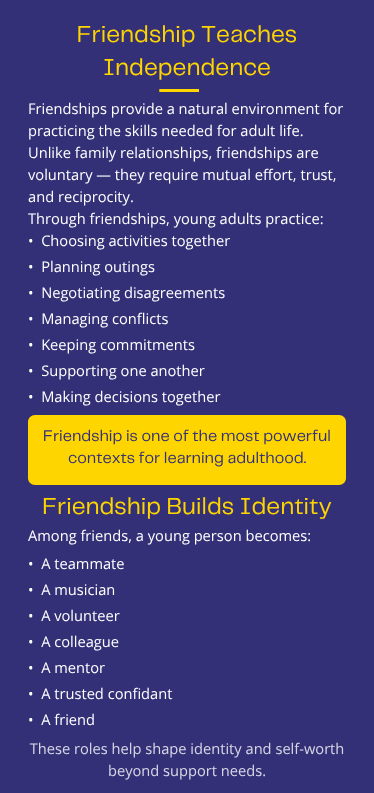
Friendship Teaches Independence in Ways Families Cannot
Parents spend years teaching young people how to communicate, solve problems, make decisions, and manage responsibilities.
Friendships provide a natural environment for practicing these skills.
When young adults:
- Choose activities with friends
- Plan outings
- Negotiate disagreements
- Manage conflicts
- Keep commitments
- Support one another
- Make decisions together
they are developing the competencies required for adult life.
Unlike family relationships, friendships are voluntary. They cannot be assigned or mandated. They require mutual effort, trust, respect, and reciprocity.
This makes friendship one of the most powerful contexts for learning adulthood.
Friendship Helps Build Identity
Young adulthood is a time when people begin to discover who they are beyond their family roles.
At home, a person may be someone’s son, daughter, brother, or sister.
Among friends, they become:
- A teammate
- A musician
- A volunteer
- A colleague
- A mentor
- A trusted confidant
- A friend
These roles help shape identity and self-worth.
Through friendships, young adults learn what they enjoy, what they value, and how they want to contribute to the world. They gain opportunities to be known for their strengths rather than their support needs.
Friendship Through the Lens of Social Role Valorization (SRV)
Social Role Valorization (SRV), developed by Wolf Wolfensberger, teaches that the good things of life are often connected to the social roles people hold.
People who occupy valued social roles are more likely to experience respect, acceptance, opportunities, relationships, and community participation. Conversely, people who occupy devalued roles are more likely to experience exclusion, segregation, and social rejection.
For many people with disabilities, society often places them in roles such as:
- Client
- Patient
- Service recipient
- Case file
- Special needs student
While services may be necessary, these roles alone do not lead to belonging.
Friendship represents a highly valued social role.
When a person is someone’s friend, they are participating in a reciprocal relationship. They are contributing to another person’s life. They are no longer viewed solely as someone receiving support; they are seen as someone who matters to others.
From an SRV perspective, helping someone develop friendships may be just as important as teaching communication skills, vocational skills, or independent living skills because friendship opens the door to many other valued roles and opportunities.
The Friendship Gap in India
In India, friendship is rarely discussed as a disability outcome.
Most disability services understandably focus on therapies, education, vocational training, and caregiving. Yet many young adults with disabilities reach adulthood with very few meaningful relationships outside their immediate family.
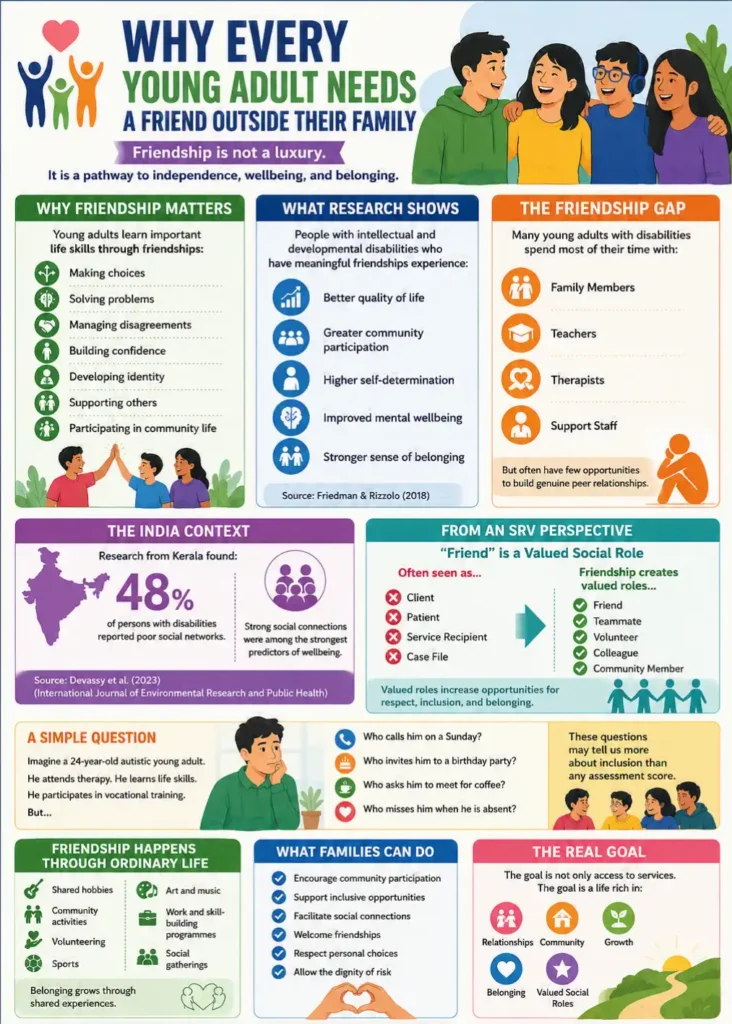
Research from Kerala found that nearly 48% of persons with disabilities reported poor social networks. The same study found that social connections were among the strongest predictors of wellbeing, even more influential than some forms of financial assistance and service access.
The researchers concluded that strong social networks provide access to emotional, social, and practical resources that contribute significantly to wellbeing.
This finding is particularly important in India, where families often remain the primary source of support throughout adulthood.
Many parents of children with disabilities express a common concern:
“What will happen when we are no longer here?”
The answer cannot rely solely on services.
Long-term security comes from relationships, community membership, and valued social roles.
An Everyday Example
Consider a 24-year-old autistic young man living in Delhi.
He attends therapy. He participates in a vocational programme. His parents are supportive. He is learning life skills and communication skills.
On paper, he is succeeding.
But what happens on a Sunday afternoon?
Who calls him to discuss a cricket match?
Who invites him to a birthday party?
Who messages him simply to say hello?
Who notices when he is absent?
If the answer is only family members and professionals, then despite receiving services, he may still be experiencing social isolation.
From an SRV perspective, he may occupy the role of client or service recipient, but not yet the valued role of friend.
Friendship Happens Through Ordinary Life
One of the biggest misconceptions about friendship is that it can be taught through social skills lessons alone.
Friendships usually emerge through ordinary shared experiences.
For example:
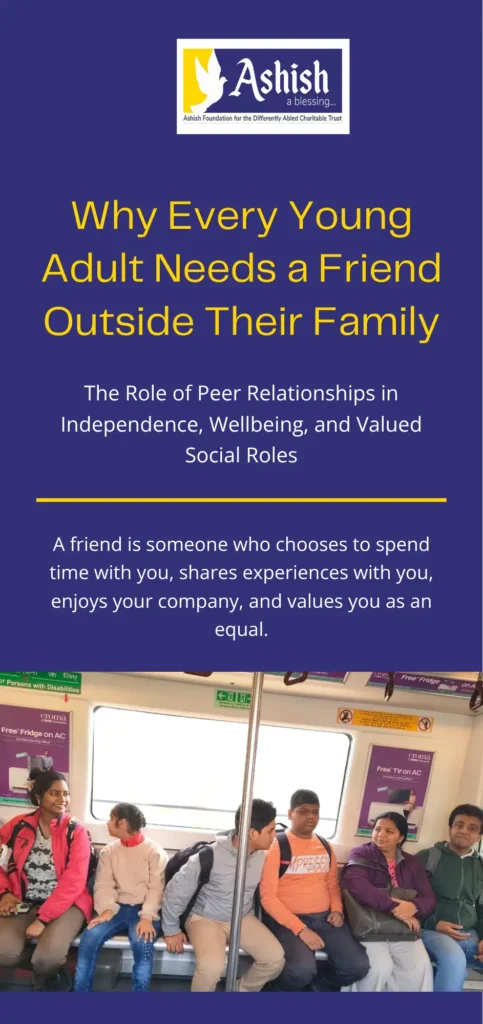
- Two young adults travel together to a community event.
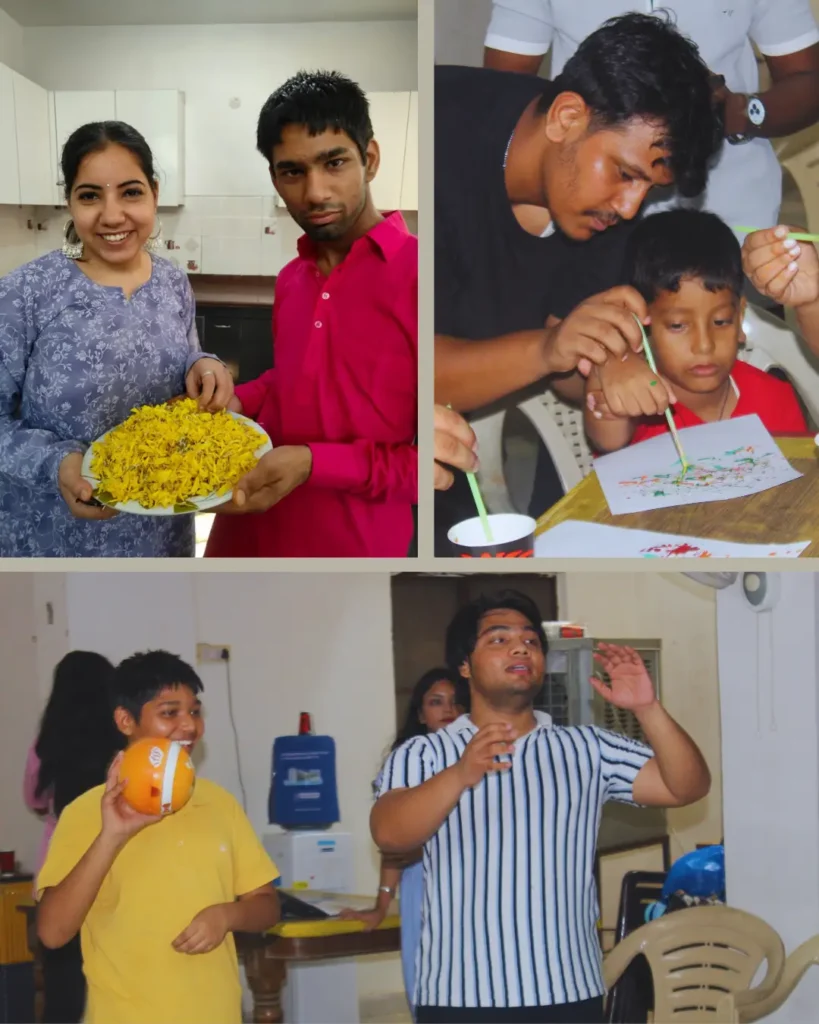
- A group of students create an art project together.
- Friends meet regularly for coffee after a vocational class.
- Young people volunteer together in the community.
- Someone is invited to join a WhatsApp group.
- A friend remembers another person’s birthday.
These experiences may seem ordinary.
Yet SRV teaches us that ordinary, culturally valued experiences are often the pathway to valued social roles.
Real friendship develops through shared interests, mutual experiences, and opportunities to contribute to one another’s lives.
Families Play a Critical Role
Families are often the strongest advocates for their children, but they can also unintentionally become the centre of a young person’s social world.
Supporting friendship development often means creating opportunities for connection.
Families can:
- Encourage participation in community groups based on interests
- Support inclusive education and employment
- Facilitate transportation to social activities
- Encourage independent communication
- Welcome peers into family life
- Respect personal preferences and choices
- Allow opportunities for social risk-taking
Friendship involves uncertainty.
Not every invitation will be accepted. Not every friendship will last.
However, the dignity of risk is part of adulthood.
Without opportunities to experience friendship, young adults are denied one of life’s most important learning experiences.
From Presence to Belonging
Many disability services successfully support community participation.
People attend classes, therapies, workplaces, vocational programmes, and recreational activities.
But presence is not the same as belonging.
A person can attend activities every day and still feel lonely.
Belonging happens when people develop relationships that continue beyond formal programmes.
It happens when:
- Someone receives a phone call from a friend.
- Someone is invited to a celebration.
- Someone is missed when they are absent.
- Someone has people to spend time with outside structured services.
These ordinary experiences are often the true indicators of inclusion.
A Different Measure of Success
For decades, disability services have measured success through goals achieved, skills acquired, therapy outcomes, and assessment scores.
These measures matter.
But perhaps we should also ask:
- Does this young person have someone to call on the weekend?
- Do they have friends who are not paid to be with them?
- Are they known and valued by people outside their family?
- Do they have opportunities to contribute to others?
- Do they occupy the valued social role of friend?
From an SRV perspective, these questions may tell us more about inclusion than any assessment score.
Conclusion
Every young adult needs friends outside their family—not because families are insufficient, but because friendship offers something unique.
Friendships build independence, strengthen identity, improve wellbeing, create belonging, and support valued social roles.
For young adults with autism and developmental disabilities, friendship is often one of the missing pieces of a good life. Yet it is also one of the most powerful pathways to inclusion.
The ultimate goal of support should not simply be to help people access services. It should be to help them build lives rich in relationships, contribution, and belonging.
Because adulthood is not defined by how many programmes a person attends.
It is defined by whether there are people who genuinely choose to share life with them.
Friendship is not an extra part of a good life.
It is one of the things that makes a good life possible.
References
- Friedman, C., & Rizzolo, M. C. (2018). Friendship, Quality of Life, and People with Intellectual and Developmental Disabilities. Journal of Developmental and Physical Disabilities, 30(1), 39–54.
- Wolfensberger, W. (2000). A Brief Overview of Social Role Valorization. Mental Retardation, 38(2), 105–123.
- Wolfensberger, W. (2013). A Brief Introduction to Social Role Valorization. Valor Press.
- Wolf Wolfensberger Archive. Social Role Valorisation.
- Devassy, S. M., Scaria, L., Yohannan, S. V., & Pathrose, S. I. (2023). Protective Role of Social Networks for the Well-Being of Persons with Disabilities: Results from a State-Wide Cross-Sectional Survey in Kerala, India. International Journal of Environmental Research and Public Health, 20(5), 4213.
- United Nations. (2006). Convention on the Rights of Persons with Disabilities (CRPD).
- Schalock, R. L., Verdugo, M. A., Gomez, L. E., & Reinders, H. S. (2016). Moving Us Toward a Theory of Individual Quality of Life.
- Fulford, C., & Cobigo, V. (2018). Friendships and Intimate Relationships Among People with Intellectual Disabilities: A Thematic Synthesis.
- Emerson, E., & McVilly, K. (2004). Friendship Activities of Adults with Intellectual Disabilities in Supported Accommodation in Northern England.
- Bigby, C. (2008). Known Well by No-One: Trends in the Informal Social Networks of Middle-Aged and Older People with Intellectual Disability Five Years After Moving to the Community.