– By Manini Mao, Ashish Foundation
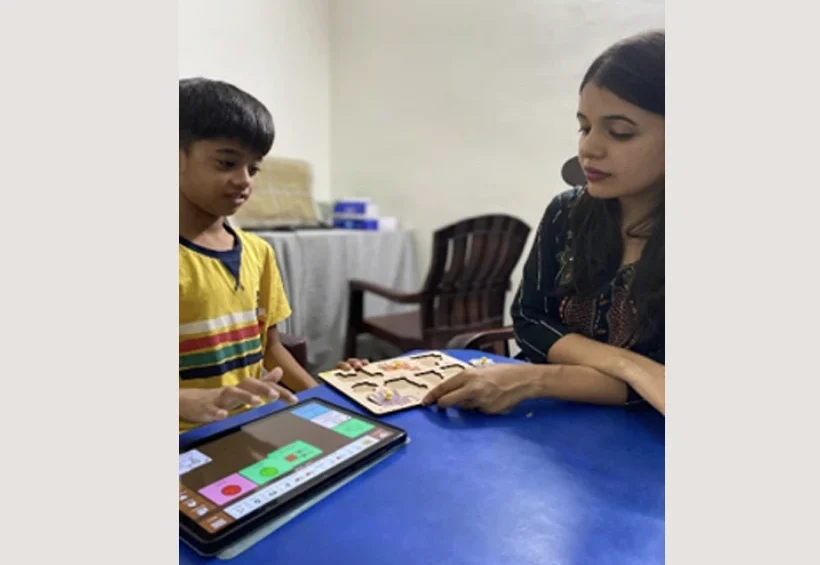
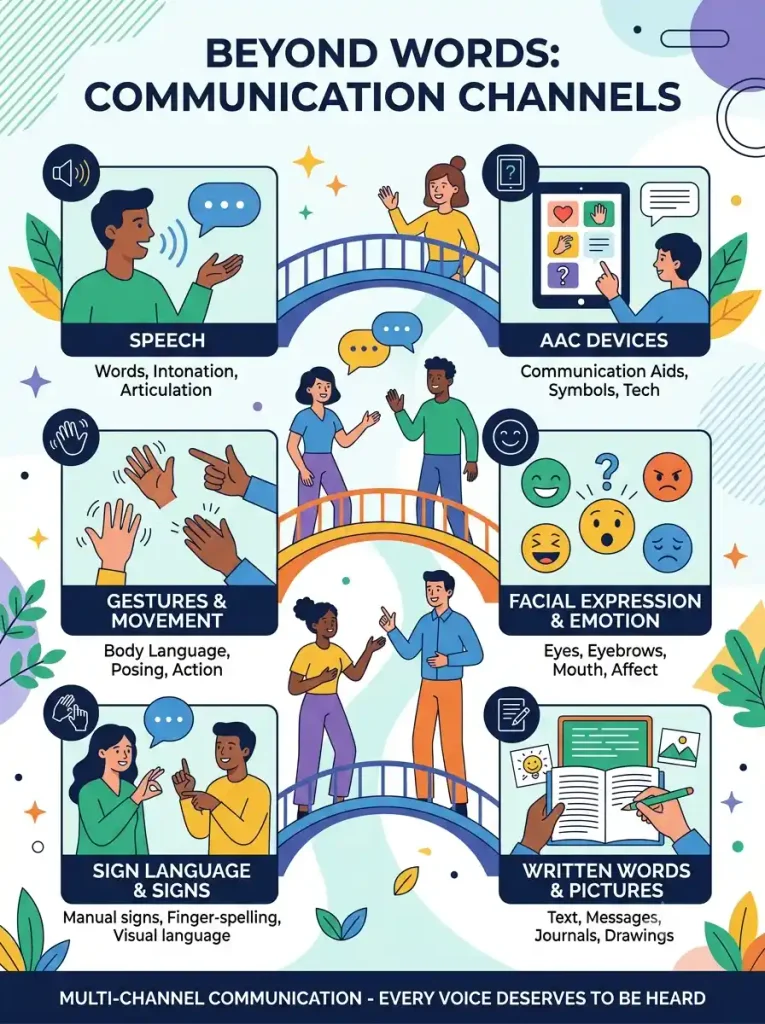
Communication is often reduced to the ability to speak. We count words, measure sentences, assess articulation, observe conversational skills, and sometimes unconsciously begin to associate conventional speech with capability. But communication does not depend on speech. People communicate through many channels: speech, gestures, movement, facial expression, sounds, gaze, signs, writing, pictures, communication devices, AAC, and other forms of expression.
The important question, therefore, is not simply whether someone can speak. It is how they communicate, how information reaches them, and whether the people around them are prepared to understand and respond.
At its core, communication is connected to our need to understand and participate in the world around us. People need information to understand what is happening, anticipate what may happen next, make decisions, seek help, build relationships, and influence their environment. Communication allows us not only to express ourselves but also to receive information that helps us navigate everyday life.
This need does not disappear because someone is autistic, has an intellectual disability, has cerebral palsy, is minimally speaking, uses AAC, or communicates differently from the majority. A person may need to know what is happening around them, understand what others expect, anticipate changes, express discomfort, make choices, establish relationships, share experiences, seek reassurance, and influence what happens to them.
A visual schedule, gesture, repeated phrase, communication device, written message, facial expression, sign, or carefully learned routine may provide access to information and predictability in ways that spoken conversation alone cannot.
This is why limited or absent speech does not, by itself, tell us how much a person thinks, understands, feels, remembers, wants, or has to say. The absence of speech should not be treated as evidence of the absence of thought, understanding, emotion, or desire.
The question we need to ask is therefore not only:
“Can this person speak?”
It is also:
“How does this person communicate, how can information reach them, and have we created an environment in which their communication can be understood and responded to?”
Communication Has to Be Two-Way
Communication is not only:
“I need a way to tell you.”
It is also:
“I need a way for you to tell me.”
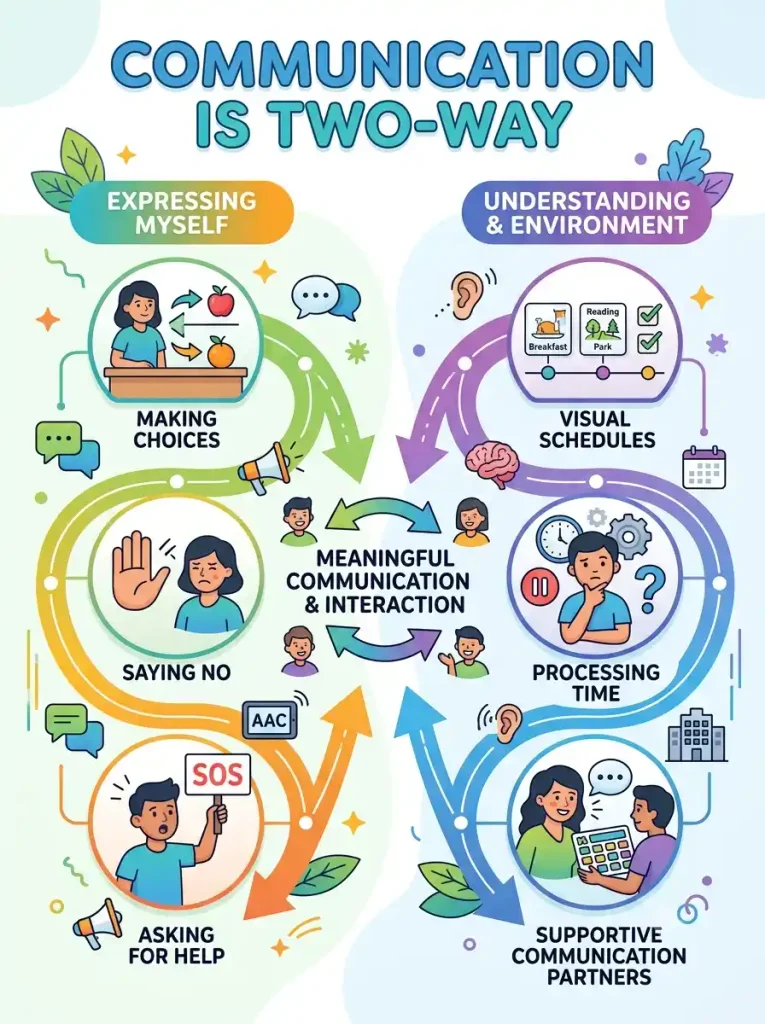
Communication access therefore involves much more than having a method for expressing wants and needs. It includes being able to receive and understand information, ask questions, clarify misunderstandings, anticipate events, make choices, participate in conversations, and understand what is happening around you.
A person cannot meaningfully participate in their own life if communication only travels in one direction.
Communication is also about agency. The ability to communicate:
“No.” “Stop.” “I don’t understand.” “I need help.” “I want something different.” “I don’t agree.”
is not simply the achievement of a language target. These messages can be tools of autonomy, safety, decision-making, and self-advocacy.
The National Joint Committee for the Communication Needs of Persons With Severe Disabilities (NJC) describes communication rights that include receiving and understanding information, asking for or refusing things, expressing preferences and feelings, making meaningful choices, participating as a communication partner, receiving responses to communication, and accessing individualized AAC and other communication supports. The current third edition of the NJC Communication Bill of Rights was published in 2024.
These principles are best understood as communication rights and practice guidance—not as a universal statute or international human-rights instrument. Their significance lies in establishing a framework for supporting meaningful communication and participation.
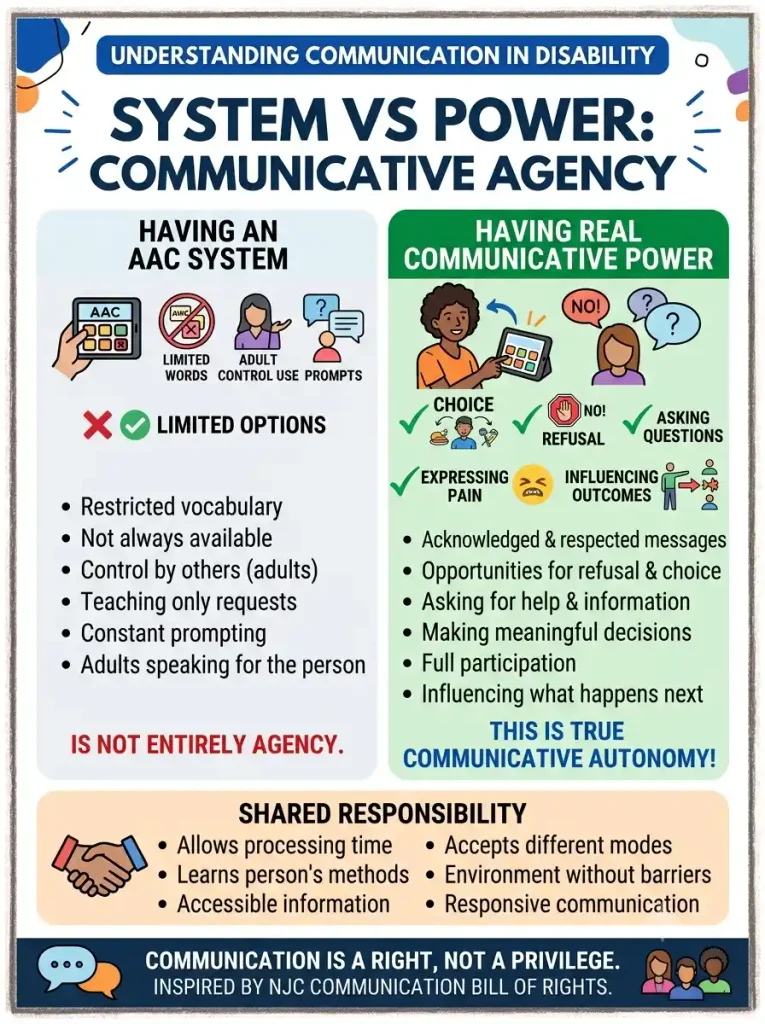
Having a Communication System Is Not the Same as Having Communication Power
A person may technically have an AAC device and still have very little communicative autonomy.
Perhaps the vocabulary available is extremely restricted. Perhaps the device is not available when the person needs it. Perhaps adults control when it can be used. Perhaps only requesting is taught while refusal, commenting, questioning, and expressing opinions are overlooked.
Perhaps the person is constantly prompted.
Perhaps adults speak for them.
Perhaps their “no” is routinely ignored.
Perhaps their messages are acknowledged but do not influence what happens.
In such circumstances, the existence of a communication system does not automatically mean the person has communicative agency.
Communication access must therefore be considered in terms of what communication makes possible.
Can the person refuse?
Can they ask for help?
Can they ask questions?
Can they express pain?
Can they make meaningful choices?
Can they change their mind?
Can they tell someone that something is wrong?
Can they participate in decisions about their own life?
Can their communication actually influence what happens next?
A communication system becomes meaningful when it gives a person genuine opportunities to participate and exercise influence—not simply when the system is present.
Communication Is a Shared Responsibility
Communication is a relationship between people. Successful communication is not solely the responsibility of the person using AAC, gestures, signs, writing, or another communication method.
Communication partners also have responsibilities.
They may need to:
- allow sufficient processing time;
- learn the person’s communication methods;
- provide information in accessible forms;
- accept different modes of communication;
- reduce environmental barriers and distractions;
- avoid speaking for the person unnecessarily;
- check that they have understood correctly;
- respond to communication, even when the desired outcome is not possible.
If one person communicates through AAC and another communicates primarily through speech, the responsibility for successful interaction does not belong entirely to the AAC user.
If someone needs more processing time, the communication partner can slow down.
If someone communicates through gestures, the partner can learn those gestures.
If information is difficult to understand, the information can be made more accessible.
If an environment is noisy or overwhelming, the environment can be changed.
ASHA’s communication-access resources similarly emphasize communication supports, accommodations, communication technologies, environmental modifications, and empowering people with communication disabilities to advocate for their own access.
Communication access therefore means changing the environment and the interaction—not continually asking the individual to change themselves.
Disability and the Environment
This perspective is also consistent with the World Health Organization’s International Classification of Functioning, Disability and Health (ICF).
The ICF considers functioning and disability within a broader context. It includes environmental factors because functioning and disability are shaped through interactions between a person’s health condition and contextual factors. Environmental factors can act as barriers or facilitators.
Communication provides a clear example.
A person may appear unable to participate when information is inaccessible, when their communication system is unavailable, or when communication partners do not understand their methods.
The same person may demonstrate meaningful participation when appropriate communication supports, accessible information, and responsive communication partners are provided.
The question is therefore not only:
“What can this person do?”
It is also:
“What is happening around this person that is making communication and participation easier or harder?”
The Role of SLPs—and Everyone Around Them
Speech-language pathologists have an important role in communication access. They may work on speech sounds, vocabulary, grammar, fluency, comprehension, social communication, literacy, and AAC.
But the larger purpose of communication intervention is not simply the acquisition of communication forms. It is what those forms make possible in everyday life.
Communication should connect people with relationships, education, healthcare, community life, decision-making, safety, and self-advocacy.
At the same time, communication access is not the responsibility of SLPs alone.
Educators, families, support staff, healthcare professionals, employers, community members, peers, and other communication partners all influence whether a person can participate meaningfully.
For SLPs, this means considering how communication skills connect to meaningful participation, relationships, self-advocacy, individual priorities, and access to everyday life. ASHA’s communication-access resources also emphasize accommodations, communication supports, and self-advocacy.
The goal should not be to make communication look conventional simply because conventional communication is easier for other people to understand.
The goal should be meaningful communication.
What Does Progress Actually Mean?
Perhaps this is where we need to rethink what we call “progress.”
Sometimes progress is a new word.
Sometimes it is a clearer sentence.
Sometimes it is a new sign or a more reliable use of AAC.
Sometimes it is initiating an interaction.
Sometimes it is asking a question.
Sometimes it is communicating pain.
Sometimes it is saying “no.”
Sometimes it is asking for help.
Sometimes it is making a meaningful choice.
Sometimes it is repairing a misunderstanding.
Sometimes it is finding a safer way to communicate frustration.
Sometimes it is participating more independently.
Sometimes it is advocating for oneself.
These moments may not always look impressive on a therapy data sheet, but they can represent something far more significant: agency, dignity, safety, independence, connection, and participation.
This does not mean that communication forms are unimportant. New words, signs, clearer speech, improved comprehension, or more effective AAC use can all represent meaningful progress.
But we should also ask:
“What has this new communication ability made possible in this person’s life?”
That question takes us beyond counting communication forms and towards understanding communication as participation.
Communication Is Not the Same as Compliance
We should also be careful not to confuse communication with compliance.
A person becoming quieter, more obedient, or more socially conventional is not automatically evidence of better communication.
At the same time, changes in behaviour or social communication can sometimes represent genuine learning, improved regulation, or increased ability to participate.
The concern is not that being quiet or socially conventional is inherently negative.
The concern is assuming that these changes automatically represent progress without asking what has actually changed for the person.
Has the person gained more ability to communicate?
Can they express disagreement?
Can they make choices?
Can they ask for help?
Can they participate more independently?
Can they influence what happens to them?
Can they communicate when something is uncomfortable or unsafe?
The key question is:
“Has this change increased the person’s ability to communicate, participate, make choices, and influence what happens to them?”
Communication should make room for disagreement.
It should make room for refusal.
It should make room for changing one’s mind.
It should make room for opinions that other people may not like.
If we teach someone to communicate only what others want to hear, we may be teaching performance rather than autonomy.
Behaviour Is Information—But We Must Keep Asking Questions
It is valuable to approach behaviour with curiosity rather than immediately labelling it as meaningless, difficult, or inappropriate.
But we should also avoid assuming that every movement, vocalisation, withdrawal, or behaviour necessarily has a deliberate communicative message.
A more useful question may be:
“What might this behaviour or communication be telling us, and what evidence do we have?”
This leaves room for many possibilities.
A behaviour may be related to communication, but it may also be influenced by sensory experiences, pain, fatigue, neurological factors, physiological needs, environmental conditions, stress, or other circumstances.
Our responsibility is not to assign a message automatically.
Our responsibility is to investigate, listen, observe patterns, reduce barriers, and remain open to what the person may be communicating through whatever channels are available to them.
The Right to Be Heard
This is where advocacy truly begins. Having a way to communicate is important. But having a voice is not enough if nobody listens.
A person may communicate “no,” but if that “no” is routinely ignored, they may possess a communication system without having meaningful communicative power.
A person may use AAC, gestures, signs, writing, or speech, but if their messages are consistently dismissed, overridden, or interpreted without checking, communication has not yet created genuine agency.
Being heard does not mean that every request must always be granted.
It means that communication is taken seriously.
It means that a person is addressed directly.
It means their communication receives a response.
It means their preferences are considered.
It means their refusal matters.
It means they are included in decisions that affect them.
It means that communication has the possibility of influencing what happens next.
The NJC Communication Bill of Rights specifically includes the right to receive a response to communication, to participate as a full communication partner, to receive and understand information, to refuse, to express preferences and opinions, and to make choices from meaningful options.
That is the difference between simply having a communication method and having communication power.
Beyond Words
Neurodivergent people should not have to communicate in a way that looks familiar to us before we decide that their communication is meaningful.
Inclusion does not mean making every person communicate identically.
It means creating a world in which different ways of communicating are anticipated, supported, respected, and given space.
Communication is ultimately a bridge between people.
We cannot directly see another person’s thoughts, feelings, experiences, fears, joys, preferences, or intentions. We come to know another person through the ways they find to share themselves with us.
Speech is one bridge.
Language is one bridge.
AAC is another.
A gesture can be a bridge.
A look can be a bridge.
A drawing, a written sentence, a sign, a movement, a vocalisation, or a repeated phrase can be a bridge.
Our responsibility is not to decide which bridges are acceptable.
Our responsibility is to make sure that everyone has a way to build a bridge—and that the people around them are willing to cross it.
Perhaps true inclusion begins when we stop asking:
“How can we make this person communicate like us?”
and begin asking:
“What can we do so that this person can communicate with us—and so that their communication can be heard?”
References & Sources:
1. National Joint Committee for the Communication Needs of Persons With Severe Disabilities. (2024). NJC Communication Bill of Rights (3rd ed.)
2. National Joint Committee for the Communication Needs of Persons With Severe Disabilities. (2025). Communication Bill of Rights, 3rd Edition: Guidance for Advocacy and Practice.
3. American Speech-Language-Hearing Association (ASHA). Communication Access.
4. World Health Organization. (2001). International Classification of Functioning, Disability and Health (ICF).