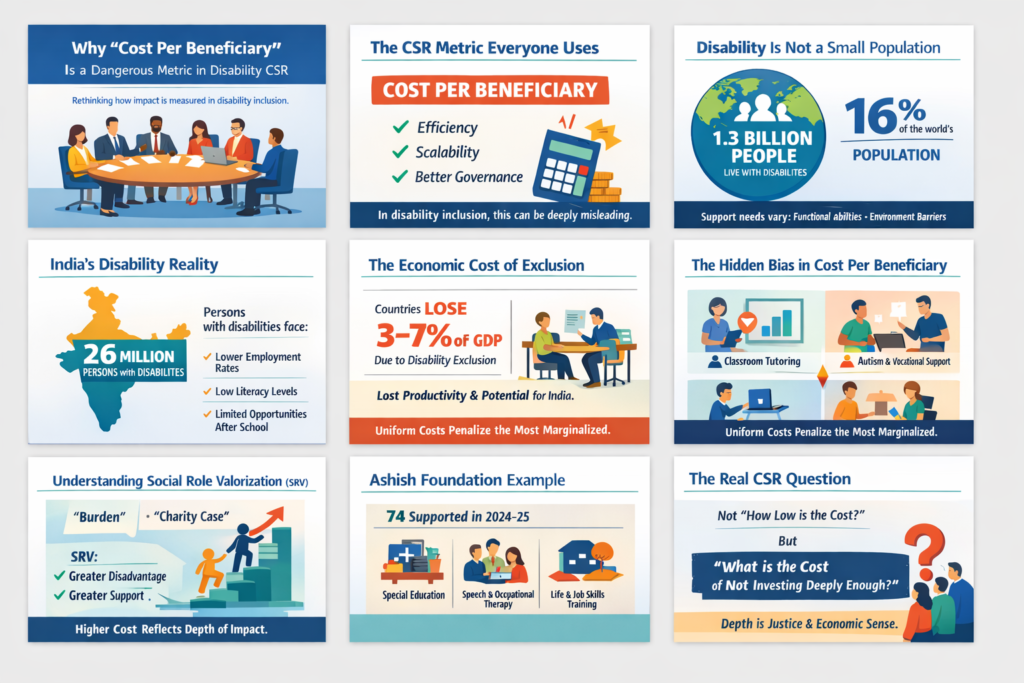
In CSR committee meetings across India, one number often dominates the discussion: cost per beneficiary. It appears neutral, rational, and financially prudent. Lower cost per head is frequently equated with efficiency, scalability, and good governance.
But in disability-focused CSR — particularly in neurodiversity and developmental disabilities — cost per beneficiary is not merely misleading; it can actively undermine real impact.
This is an uncomfortable truth for boards and CSR heads, yet one that social impact leaders can no longer afford to ignore.
The Hidden Bias Inside Cost-Per-Head Calculations
Cost-per-beneficiary metrics assume that all beneficiaries begin from comparable positions and require similar levels of support. Disability research demonstrates that this assumption is fundamentally flawed.
Globally, more than 1.3 billion people — approximately 16% of the world’s population — live with significant disability, according to the World Health Organization. Disability is not a uniform category; support intensity varies dramatically depending on functional needs, environmental barriers, and accumulated social disadvantage.
Uniform costing models ignore this variation.
The Indian Reality
According to the National Statistical Office (2019), approximately 2.2% of India’s population — over 26 million people — are identified as persons with disabilities. Experts widely acknowledge that this figure underestimates prevalence due to definitional and reporting constraints.
More critically:
- Labour force participation among persons with disabilities is significantly lower than the national average.
- Literacy rates remain below general population levels.
- Women with disabilities face compounded disadvantage in education and employment.
The World Bank estimates that exclusion of persons with disabilities can cost countries between 3–7% of GDP due to lost productivity and social exclusion.
For India — now among the world’s largest economies — this represents not just social injustice but macroeconomic leakage.
Recent coverage in national dailies such as The Hindu and The Indian Express has repeatedly highlighted the employment gap for neurodivergent adults and the limited availability of structured transition services post-schooling. The issue is not awareness — it is sustained investment.
When CSR frameworks reward lower per-person costs, they unintentionally penalise organisations working with the most marginalised populations — precisely those CSR is intended to prioritise.
What Social Role Valorization Predicts
The theory of Social Role Valorization (SRV), developed by Wolf Wolfensberger (1983, 1998), provides a powerful explanatory framework.
SRV argues that individuals who are socially devalued — including persons with developmental disabilities — are at high risk of being cast into negative roles such as “burden,” “charity case,” or “eternal child.” These roles restrict life chances, reduce access to valued opportunities, and diminish societal respect.
From this foundation, SRV predicts two key implications relevant to CSR:
- The greater the social devaluation a person has experienced, the more intentional, structured, and resource-intensive the intervention required to support movement into valued social roles.
- Low-cost or low-structure services often replicate segregation or low-expectation models, thereby reinforcing rather than reversing devaluation.
A central refinement within SRV is the Conservatism Corollary (Wolfensberger, 1998), which states:
The more vulnerable or socially devalued a person is, the more carefully, competently, and intentionally supports must be designed and delivered.
Reducing cost per beneficiary in highly vulnerable groups is therefore not necessarily efficiency — it may represent elevated risk.
This interpretation aligns with India’s Rights of Persons with Disabilities Act, 2016, which emphasises dignity, equality, and full participation — not minimal service provision.
Why Neurodiversity Programmes Appear “Expensive”
Neurodiversity-focused programmes frequently report higher per-beneficiary costs due to:
- Low staff-to-learner ratios
- Specialised professional expertise (occupational therapy, speech therapy, behavioural supports)
- Long-term engagement rather than short project cycles
- Family, workplace, and community integration efforts
The Organisation for Economic Co-operation and Development reports employment rates for persons with disabilities remain 20–30 percentage points lower than non-disabled peers across member countries. Similar gaps persist in India.
Economist James Heckman’s longitudinal research demonstrates that early and intensive interventions produce high long-term rates of return by reducing later dependency costs (Heckman, 2011).
Seen narrowly, higher per-beneficiary cost may trigger discomfort in CSR reviews.
Seen strategically, these costs reflect depth — not inefficiency.
Disability Sector Voices
Disability scholar Tom Shakespeare argues that meaningful inclusion requires structural change, not symbolic participation. Structural change is rarely low-cost.
The American Association on Intellectual and Developmental Disabilities emphasises that outcomes are directly correlated with the intensity and appropriateness of supports provided. Uniform funding models fail to reflect this principle.
The International Labour Organization has consistently noted that inclusive employment systems generate macroeconomic gains when sustained over time — not when implemented as short-term compliance exercises.
Within India, accountability bodies such as Credibility Alliance stress that professional staffing, governance systems, and long-term engagement are prerequisites for sustainable impact. All of these increase short-term cost — while reducing long-term failure risk.
Ashish Foundation: Depth Over Volume
At Ashish Foundation for the Differently Abled Charitable Trust, this debate is not theoretical — it is operational.
In 2024–25, 74 children, adolescents, and young adults with autism and developmental disabilities received structured support across:
- Special education
- Occupational therapy
- Speech therapy
- Sensory integration
- Life-skills training
- Vocational training and customised employment
The Foundation’s approach is explicitly aligned with Social Role Valorization principles:
- Movement from “care recipient” to learner
- From “dependent child” to worker
- From “beneficiary” to contributor
- From “isolated family” to community participant
Impact Calculations: Looking Beyond Cost Per Head
If one were to calculate only annual cost per beneficiary, the figure may appear higher than mass-outreach education programmes.
But consider alternative metrics:
- Dependency Reduction
Structured therapy and life-skills development reduce long-term care intensity.
Reduced future institutionalisation or full-time dependency represents substantial avoided social cost. - Intergenerational Multiplier
When one young adult with disability secures employment:- Family financial stress reduces
- Siblings’ educational continuity improves
- Maternal workforce participation may increase
This is not a per-beneficiary outcome. It is a systems-level shift.
The Cost of Underinvestment
The UNICEF reports that children with disabilities in low- and middle-income countries are significantly less likely to complete secondary education.
Underinvestment today becomes fiscal burden tomorrow.
The economic cost of exclusion is measurable.
The social cost is generational.
What Better CSR Metrics Look Like
If cost per beneficiary is inadequate, what should CSR leaders measure?
SRV-aligned and evidence-informed metrics include:
- Progression into valued social roles (learner, worker, contributor)
- Retention in employment beyond 12–24 months
- Increased independence in daily living
- Reduction in long-term dependency
- Sustained family stability
- Community participation indicators
These metrics align with Schedule VII of the Companies Act, 2013, ESG commitments, and long-term value creation.
Depth may involve smaller cohorts and longer timelines.
But it produces durable returns.
The Strategic Question CSR Leaders Must Ask
The real question is not:
How low is the cost per beneficiary?
But:
What is the cost of not investing deeply enough?
Underinvestment in disability does not save money.
It shifts cost to families, women caregivers, welfare systems, and future public budgets.
For CSR to align with both evidence and ethics, it must reward intensity where intensity is required.
In disability inclusion, depth is not inefficiency — it is justice.
And in organisations like Ashish Foundation, it is also measurable economic prudence.
—
References:
- American Association on Intellectual and Developmental Disabilities. (2010). Intellectual disability: Definition, classification, and systems of supports (11th ed.). AAIDD.
- Heckman, J. J. (2011). The economics of inequality: The value of early childhood education. American Educator, 35(1), 31–47.
- Heckman, J. J., Moon, S. H., Pinto, R., Savelyev, P., & Yavitz, A. (2010). The rate of return to the HighScope Perry Preschool Program. Journal of Public Economics, 94(1–2), 114–128.
- International Labour Organization. (2015–2022). Disability and employment policy briefs. ILO.
- Ministry of Corporate Affairs. (2013). Companies Act, 2013 (Schedule VII). Government of India.
- National Statistical Office. (2019). Persons with disabilities in India: NSS 76th Round (July–December 2018). Ministry of Statistics and Programme Implementation, Government of India.
- OECD. (2010). Sickness, disability and work: Breaking the barriers. OECD Publishing.
- Rights of Persons with Disabilities Act, 2016. Government of India.
- Shakespeare, T. (2013). Disability rights and wrongs revisited. Routledge.
- UNICEF. (2021). Seen, counted, included: Using data to shed light on the well-being of children with disabilities. UNICEF.
- Wolfensberger, W. (1983). Social role valorization: A proposed new term for the principle of normalization. Mental Retardation.
- Wolfensberger, W. (1998). A brief introduction to Social Role Valorization: A high-order concept for addressing the plight of societally devalued people. Syracuse University Training Institute.
- World Bank. (2007). People with disabilities in India: From commitments to outcomes. World Bank.
- World Bank. (2020). Disability inclusion overview. World Bank.
- World Health Organization. (2011). World report on disability. WHO.
- World Health Organization. (2023). Global report on health equity for persons with disabilities. WHO.